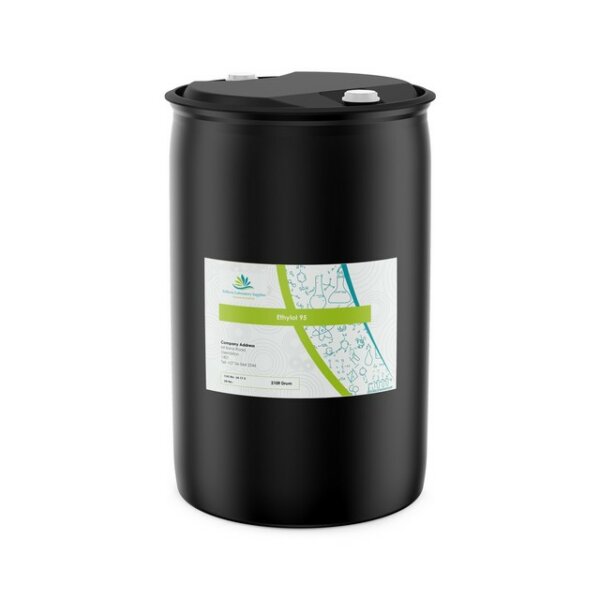

Ethylol 95 is a highly flammable liquid used as a raw material for aerosol propellants and printing ink additives. For industrial use only. It contains 95.20% Ethanol and 4.30% Isopropyl alcohol. It is colorless with an alcohol-like odor and is partly miscible in water. It has a boiling point of 78.4°C and a flash point of 12°C. Safety precautions include keeping away from open flames and using personal protective equipment.
CAS Number: 141-78-6. Synonyms: Acetic Ester, Ethyl Ethanoate, EtOAc.
• form: Liquid
• state_of_matter: Liquid at 20°C, 1,013 hPa
• color: Colorless
• odor: Alcohol-like
• pH: Neutral
• melting_point: -88.5°C
• boiling_point: 78.4°C
• flash_point: 12°C (Closed cup)
• autoignition_temperature: 363°C
• lower_explosion_limit: 3.3% (V)
• upper_explosion_limit: 19% (V)
• density: 0.791 g/cm³ at 20°C
• water_solubility: Partly miscible
• solubility_in_other_solvents: Completely soluble in Diethylether
• viscosity_dynamic: 2.4 mPa.s
• relative_vapour_density: 2.08
• hazards: Highly flammable (R11). Irritating to eyes (R36). Vapors may cause drowsiness and dizziness (R67).
• first_aid_measures: {‘inhalation’: ‘Move to fresh air. If breathing is irregular or stopped, administer artificial respiration.’, ‘skin_contact’: ‘Wash off immediately with plenty of water for at least 15 minutes.’, ‘eye_contact’: ‘Rinse immediately with plenty of running water for at least 15 minutes.’, ‘ingestion’: ‘Do not induce vomiting. Call a physician immediately.’}
• firefighting_measures: Use water spray, dry powder, or alcohol-resistant foam. Cool containers with water spray.
• accidental_release_measures: Soak up with inert absorbent material and dispose of as hazardous waste.
• handling_and_storage: Keep containers tightly closed in a cool, well-ventilated place. Use explosion-proof equipment.
• exposure_controls: Provide sufficient ventilation. Wear suitable respiratory equipment, gloves, safety glasses, and protective suit.
• stability_and_reactivity: Avoid oxidizing agents, acids, and bases. Hazardous decomposition products include carbon oxides.
• toxicological_information: {‘acute_oral_toxicity’: ‘Ethanol: LD50 rat: 7,060 mg/kg. Isopropyl alcohol: LD50 rat: 5,045 mg/kg.’, ‘acute_inhalation_toxicity’: ‘Ethanol: LC50 rat: 66,000 mg/l (4h). Isopropyl alcohol: LC50 rat: 16,000 mg/l (8h).’, ‘acute_dermal_toxicity’: ‘Ethanol: LDLo rabbit: 20,000 mg/kg. Isopropyl alcohol: LD50 rabbit: 12,800 mg/kg.’}
• ecological_information: {‘toxicity_to_fish’: ‘Ethanol: LC50 Pimephales promelas: 15,300 mg/l (96h). Isopropyl alcohol: LC50 Pimephales promelas: >6,000 mg/l (96h).’}
• disposal_considerations: Dispose of in accordance with local regulations. Store containers and offer for recycling.
• transport_information: {‘ADR’: ‘UN number: 1170; Class: 3; Packaging group: II; F1; Description: ETHANOL’, ‘RID’: ‘UN number: 1170; Class: 3; Packaging group: II; F1; Description: ETHANOL’, ‘IMDG’: ‘UN number: 1170; Class: 3; EmS: F-E, S-D; Packaging group: II; Description: ETHANOL’, ‘ICAO/IATA’: ‘UN number: 1170; Class: 3; Packaging group: II; Description: Ethanol’}
• regulatory_information: {‘symbols’: ‘F: Highly flammable’, ‘R_phrases’: ‘R11: Highly flammable.’, ‘S_phrases’: ‘S9, S16, S23, S33, S36, S60, S3/7’}
• 5lt
• 25lt
• 210lt
• 1000lt
Bulk Chemicals
Related products

Other

Other


Other

Other
Other

Other

Other

Other